Monday, 7 September 2015

Too "Twee" for Words!

Before we headed to the Bletchley Park and the Midlands (Birmingham and Chesterfield), we spent several days in the Cotswolds.  The countryside and villages in that area could not be more picturesque and quaint.  The Cotswolds are roughly 25 miles (40 km) across and 90 miles (145 km) long, stretching south-west from just south of Stratford upon Avon to just south of Bath. It lies across the boundaries of several English counties; mainly Gloucestershire and Oxfordshire and parts of Wiltshire, Somerset, Worcestershire and Warwickshire.  During the Middle Ages, the Cotswolds became prosperous from the wool trade with the continent, with much of the money made from wool directed towards the building of churches.  Many of the buildings are made from the very unique honey-coloured Cotswold stone which can vary in colour from dark to very light.  There are a myriad of charming villages to explore here - some very well known and others, hidden treasures.  We managed to see quite a number of them.  Our first stop was in Stow-in-the-Wold where the village square still has the old stocks in place.  Our base for this part of the trip was Bourton-in-the-Water, a quite touristy village on the River Windrush (think "small stream" - not a river!).  We also visited Lower Slaughter and its iconic waterwheel (yet another "star" in many English country calendars) and managed to get to Bibury to see the National Trust cottages in Arlington Row.  These are former weavers' cottages dating from the 1500s. 

The Green at Stow-in-the-Wold
The Stocks on the Green at Stow
 
The Water Wheel at Lower Slaughter

The River Windrush at Burton-on-the-Water
Arlington Row National Trust Weavers' Cottages at Bibury
As we were leaving this area, we quickly visited Snowshill (in the rain), Broadway, and Chipping Campden. 

Snowshill Church in the Rain

The Lygon Arms in Broadway


Store Fronts in Broadway
Former Wool Market in Chipping Campden


Sunday, 6 September 2015

Where Fiction and Reality Meet

Over the last few days, we have had three occasions where fiction and reality more or less overlapped.

Highclere Castle

Highclere Castle
Thursday, we went to Highclere Castle, which is the film location for Downton Abbey.  The castle is one of England's most beautiful Victorian Castles set amidst 5,000 acres of spectacular grounds.  The castle is in the Jacobethan style and the park was designed by Capability Brown.  Located in Hampshire about 5 miles south of Newbury, Berkshire, it is the actual home of the Carnarvon family which has lived at Highclere since 1679.  Alternatively, in the TV series, the castle is used to portray the fictional Yorkshire country estate of the aristocratic Crawley family and their servants in the post-Edwardian era.  During the tour of the castle, we visited the fictitious bedrooms of "Lady Sybil" and "Mary" which, in reality, are some of the Carnarvon family's  bedrooms.  While we have lots of photos of the grounds, photography was prohibited in the castle itself.  However, we got a good idea about how the real family lives and, of course, we all know the story of the Earl of Grantham and the rest of the Crawley family.


 Bletchley Park
The Huts where the
Codebreakers worked
The Mansion at Bletchley Park
Work Stations in one of the Huts


Friday, we had another convergence of reality with fiction when we visited Bletchley Park.  Located in Milton Keynes in Buckinghamshire, this was the site of the United Kingdom's Government Code and Cipher School which, during the Second World War, regularly penetrated the secret communications of the Axis Powers  – most importantly the German Enigma and Lorenz ciphers.  The official historian of World War II British Intelligence has written that the intelligence produced at Bletchley shortened the war by two to four years, and that without it the outcome of the war would have been uncertain.  The site is now an educational and historical attraction memorialising and celebrating those accomplishments. 


The story of Albert Turing and Bletchley Park was, of course, depicted in the 2014 movie, The Imitation Game.  Turing was a British pioneering computer scientist, mathematician, logician, and cryptanalyst.  He was highly influential in the development of computer science and created the Turing machine, which can be considered a model of a general purpose computer.  Turing is widely considered to be the father of computer science and artificial intelligence. In 1952, however, the police arrested Turing on charges of 'gross indecency', an accusation that would lead to his devastating conviction for the criminal offense of homosexuality - and his subsequent suicide.  At the time, little did officials know they were actually incriminating the pioneer of modern-day computing.  The movie provides an intense and haunting portrayal of a brilliant, complicated man.  At Bletchley Park, we saw the official document signed by Gordon Brown apologizing to Turing posthumously for the way he was treated.  The real question is what else would he have conceived or invented if his life had not been cut short.  He was only about 42 when he died.

The Black Country Living Museum


In the Village with Clair, Harriet and Esme 
Saturday, while we were staying in Birmingham, we visited the Black Country Living Museum in Dudley.  I'd heard about this place from my friends, Mena and Trevor, and wanted to see it for myself.  It is an open-air museum of rebuilt historic buildings in. The museum occupies 105,000 square metres (26 acres) of former industrial land partly reclaimed from a former railway goods yard, disused lime kilns and former coal pits.  Opened in 1978, the museum preserves some important buildings from around the Metropolitan Boroughs of Dudley, Sandwell and Walsall plus the City of Wolverhampton. These buildings are mainly in a specially built village. Most buildings were relocated from their original sites to form a base from where volunteers portray life in the period from the 1850s to the 1950s. In addition to visiting the buildings, you can ride on old trams and trolley buses, attend a lesson in a school classroom at it would have been taught around 1919, ride on canal boats into the mines, and visit a "fun fair" from the early 20th century.  It was interesting to experience this "step back in time" and it showed us all the reality of how difficult life would have been in the mining villages in the Black Country at that time. 
 

The Colliery Office and Steam Engine Room
           
The Village Sweet Shop
The Pharmacy (Clair who is a
   pharmacist loved this!)
A Typical Pit Cottage
The Hand-operated Merry-Go-Round


Thursday, 3 September 2015

Pubs - Opus One!

Okay, I've talked about the cathedrals (although probably not enough for some people) but, to date, I've totally neglected mentioning any pubs - and it isn't exactly like we haven't been in quite a few!  So, this blog is going to be about some of the ones we've visited.  We haven't been in every one we've seen but we've taken some photos of them too!

Kathleen's first "awakening" was that the Brits distinguish between beer and lager. - and they are quite different.   After ordering beer a couple of times and finding it too "beery", she now orders lager.  However, because the Brits don't appear to actually make many lagers, she has been reduced to having Foster's, Carlsberg, St Miguel, none of them English!  Imagine her disappointment when she found out she wouldn't be sampling English "beer".  I'm trying to convince her to branch out, be more flexible, and work on developing a taste for British beer but no luck so far!  

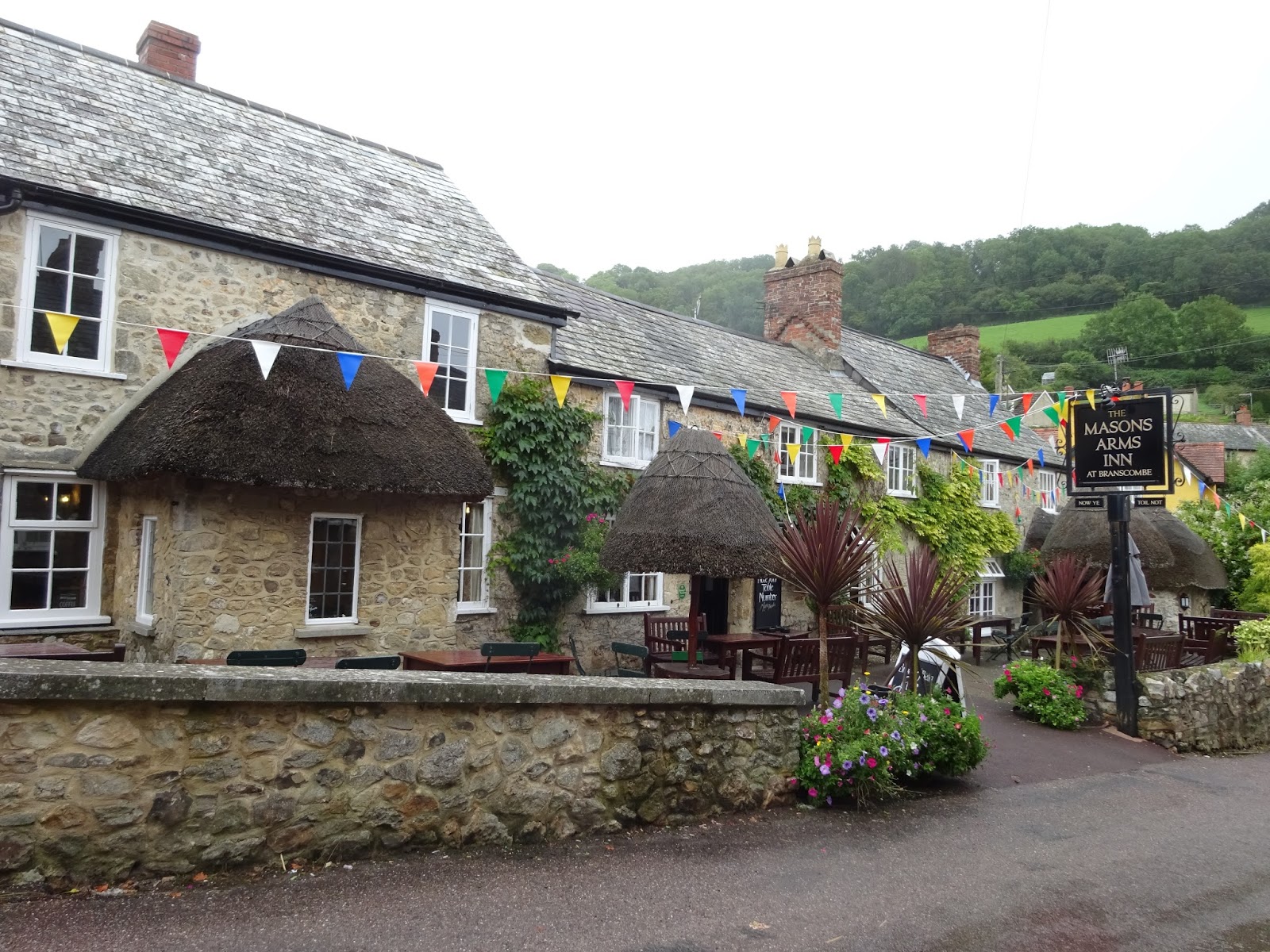
Okay, back to the pubs.  One of first "oldie-worldie" ones we went into was in Branscombe (Devon) where I took Mom's cousin and her husband a few years ago.  I'm sure the Masons Arms must date from the 16th or 17th century.  The ceilings and floors are all uneven and it all adds to the charm.

The Mason Arms in Branscombe

Bar at the Masons Arms
Fireplace at the Masons Arms


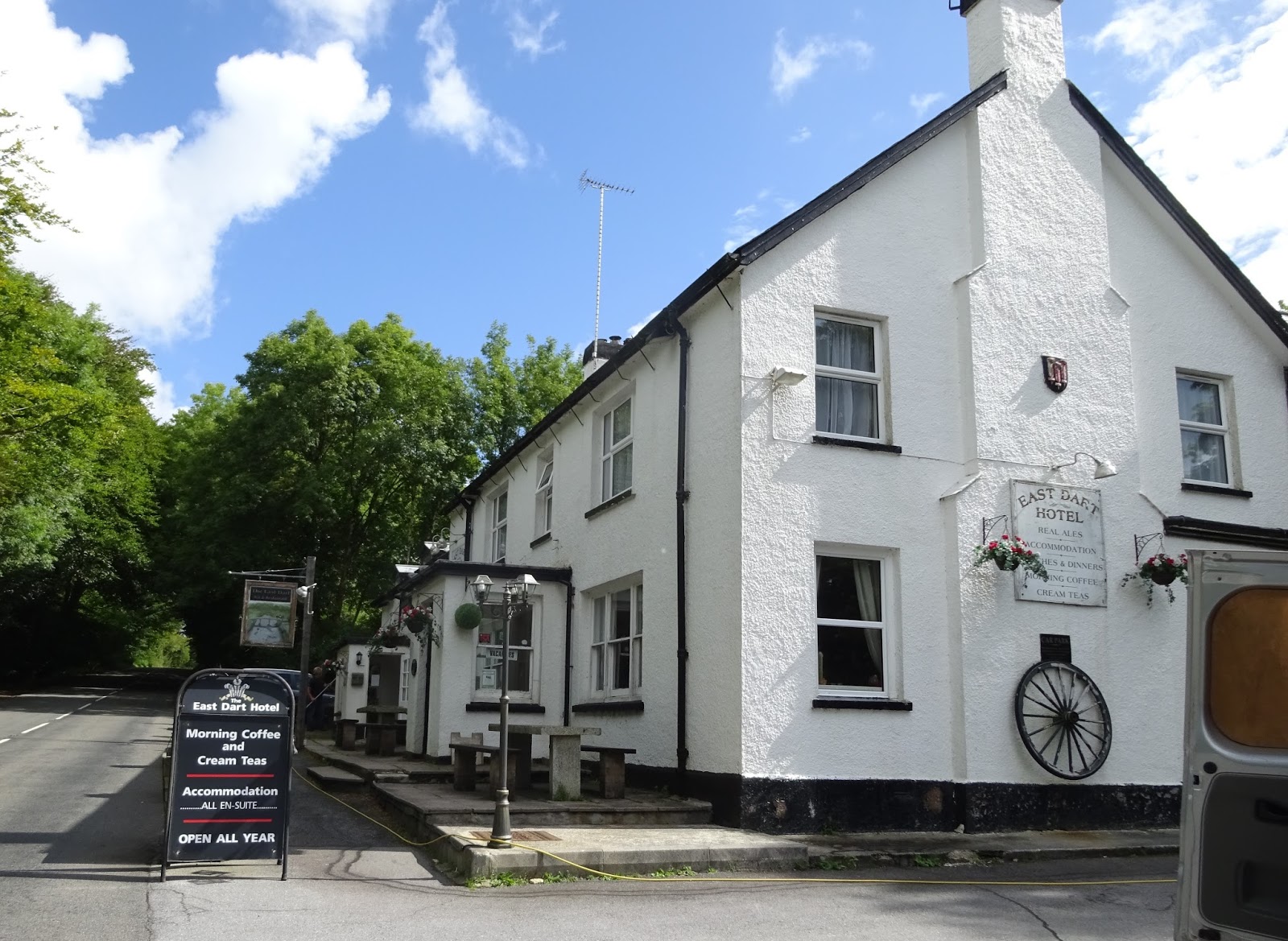
Behind the bar at the East Dart Hotel
Up on Dartmoor, we stopped in at the pub in Postbridge for an orange juice and a tea - yes, really!  Even so, the guy was still happy to take our picture behind the bar.   


Ye Olde Salutation Inne - East Looe
In Looe, we had a drink in one pub that dates from the 15th century and then another which purports to be the "oldest pub in Looe".  Not sure which one wins that contest but since one was on the east side and the other one the west, maybe they are both right.  Both were filled with locals, mostly fisherman in the one in West Looe.


Inside the Jolly Sailor


The Jolly Sailor (West Looe)


The Ship Inn in Mousehole
Further west in Cornwall, we stopped for a light lunch in a pub in Mousehole called The Ship Inn.  There seems to be one with that name in every village along the Cornish coast!


Kath at the bar in The Ship Inn
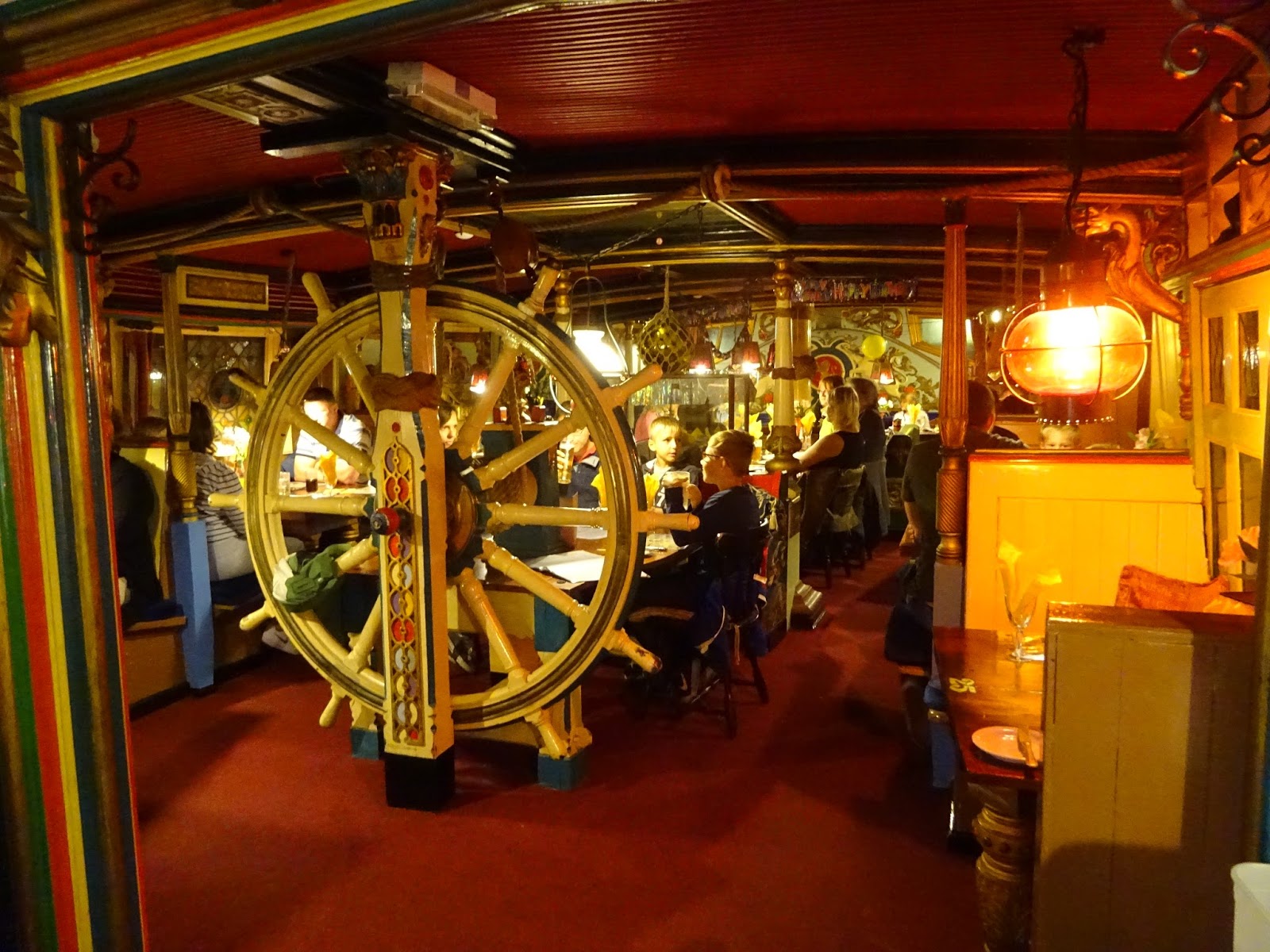
Back in Penzance that evening, we had dinner in a very funky (and old) pub called The Admiral Benbow.  The front of the pub was chock-a-block full of knick-knacks, etc. and the back was fashioned like the stern of a ship.  The floors were again really uneven and the ceilings quite low.  It was an "interesting" evening as they say and having dinner there was a lot of fun.

Penzance's Admiral Benbow
and the restaurant


Inside the Admiral Benbow bar


Dinner at the Admiral Benbow
So, that about sums up the first week or so of our pub experiences.  There is a reason why the title of this blog is Opus One.  You can expect more on this topic!

Tuesday, 1 September 2015

More Moors

When I was a child, I read stories about the English moors and the wild ponies found on them.  I didn't actually believe they existed until I went to the UK in 1979 and saw them first hand.  Since then, I've loved visiting the moors, whether they be here in the southwest or in the north (Derbyshire and Yorkshire), where they aren't ponies but lots of sheep.  I've already posted pics of the ponies, the sheep and the scenery of Dartmoor but, today (Tuesday) we drove along the north coast of Devon in Exmoor.  The heather was in full bloom, it was sunny and the scenery was breathtaking.

Exmoor with the Heather in Bloom

Views from Exmoor looking East
Exmoor Ponies


The Amazing Cornish Coastline

The last couple of days have been spent further exploring the fabulous Cornish coastline. One place I'd wanted to visit for a number of years was St. Michael's Mount, having visited its "French twin", Mont St. Michel several times.  So, Sunday we took the bus from Penzance to Marazion and, because the tides were cooperating, we walked along the causeway to the island.  When the tide is higher, you have to take a boat.  I'm not exactly sure of the history of this place but, unlike Mont St. Michel which is topped with an abbey, this one has a castle.  We didn't visit it but did wander around the shops and harbour before walking back to the mainland.

St. Michel's Mount at low tide from Marazion
The walk along the causeway
Some of the buildings on the island


Monday, we left Penzance and had a busy day hurtling up and down the Cornish lanes to several places we wanted to see.  As it turns out, we didn't allow for nearly enough time in Cornwall - of course that gives me a reason to come back.  I didn't know that this area was designated as a UNESCO World Heritage Site because of its mining history (tin and copper).  We took a photo of one of the abandoned mines but I didn't manage to find the location of the one I've seen on the Internet. We also stopped at the Poldark Mine but it seemed closed for the bank holiday.
 
Former mine site not far from Penzance
Our day actually started with a quick trip to St. Ives.  Kath had been there years ago (I also think I'd visited it with Mom) so we wanted to check it out.  From there we headed south to Lizard where some people at a pub had told us there was an amazing area called Kynance, a National Trust location.  They were not wrong.  The coastline from there was stunning.  Again, we regretted not having more time to explore it.  Next, it was on to Mullion Cove for another photo op then to Perranporth where Kath had camped with her friend about 40 years ago.  The beach there is spectacular (similar to Parkville) and was crowded with people enjoying the last of the bank holiday weekend.

The Harbour at St. Ives


Kynance Coast
Another View at Kynance


Mullion Cove


The Beach at Perranporth
Busy Bank Holiday at Perranporth


Next it was on Tintagel, of King Arthur lore.  It is located on another section of the dramatic Cornish coastline which seems to alternate from being wild and rocky to having lovely sandy beaches. 

Tintagel

Looking toward Merlin's Cave at Tintagel
Monday, we also said our good bye to Cornwall and drove into North Devon where the scenery was equally spectacular.  More about that next!